BLOG



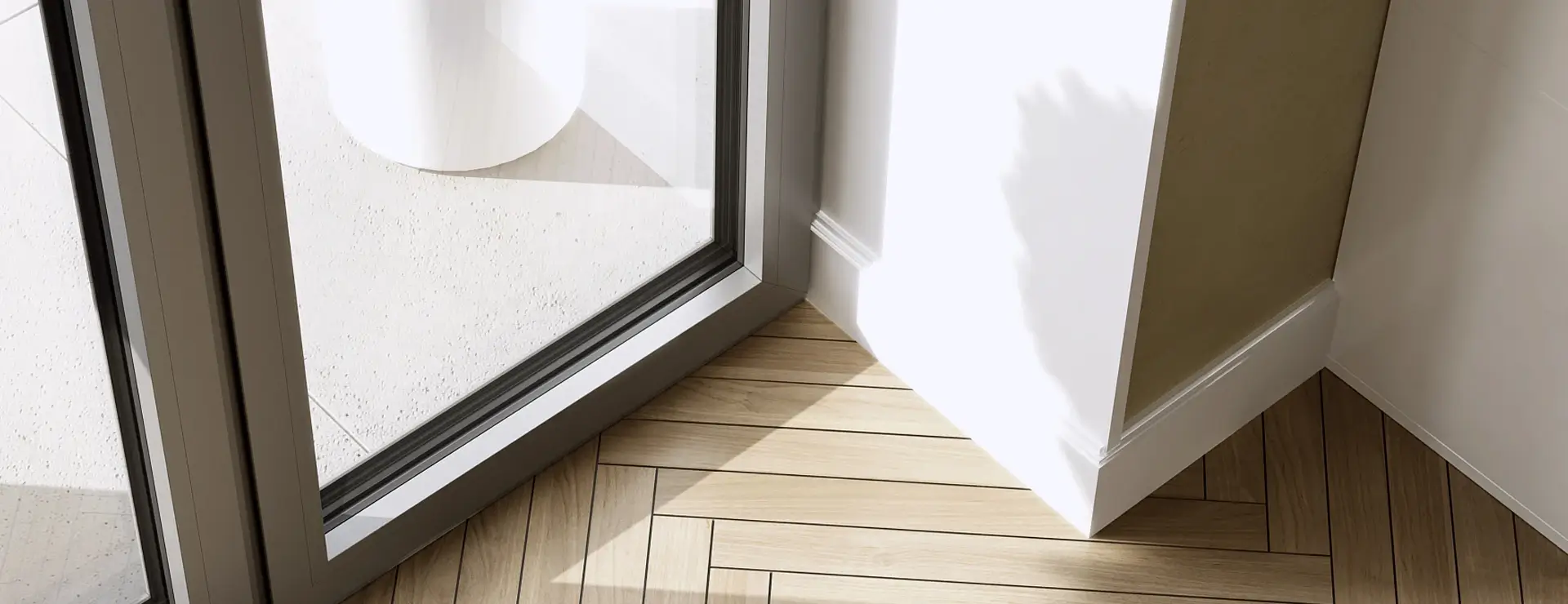
It is precisely these that can cause cool spots near glazing, condensation or higher energy consumption than would be indicated by design calculations, even in a modern home.
A thermal bridge is a point in a partition where the thermal resistance is lower than in the rest of the structure. In windows and doors, it most commonly occurs within the frame, at the junction between the frame and the wall, and at the points where profiles join. The result is faster heat transfer, which leads to a reduction in the temperature of the window’s inner surface. From the user’s perspective, this manifests itself not only in higher heating bills but also in a noticeable sense of discomfort near the glazing. In practice, a thermal bridge around a window:
It is worth emphasising that the problem of thermal bridges does not apply exclusively to old or poorly selected windows. Even modern window frames, if not fitted correctly, can lead to energy loss. For this reason, the insulation performance of aluminium windows should be assessed not only in terms of the declared parameters, but also in terms of proper installation.
In modern aluminium joinery, the use of thermal breaks – elements that separate the outer part of the profile from the inner part – plays a key role in minimising thermal bridges. A good example is the MB‑86N aluminium windows, which feature wide thermal breaks. Thanks to these, the frame maintains stable thermal performance even when there are significant temperature differences between the interior and the outside environment. The MB‑86N model achieves very good Uw values (as low as 0.62 W/m²K), making it a popular choice for modern detached houses with large glazed areas.
An even higher level of heat loss control is offered by the MB‑104 Passive windows, designed for buildings with very high energy performance requirements. Their Uw value can reach 0.53 W/(m2K), meeting and even exceeding the standards for passive house construction. In this model, the thermal breaks are made of polyamide, and the profile features an extensive chamber structure, which significantly reduces linear thermal bridges within the frame. This results in a higher temperature on the window’s inner surface and a lower risk of condensation.
In modern detached houses, large glazed areas are becoming increasingly common, requiring very effective control of heat loss. When the profiles are in greater contact with the environment and the heat exchange surface area increases, thermal bridges may occur. Particular attention must be paid to corner joints in external sliding doors, which place high demands on thermal insulation. This is because not only are there large glazed areas, but also joints between components at the corner of the building – an area where there is an increased risk of thermal bridges forming. The design of the profiles used in Aluprof products allows the insulation to remain continuous even in this critical area. This results in an even temperature distribution across large glazed areas and the absence of noticeably cold zones in the corners of rooms. For the user, this means not only greater comfort but also the ability to fully utilise the architectural potential without compromising on energy efficiency.
In energy-efficient homes, thermal bridges can occur as a result of incorrect installation, in places where the external envelope is at its weakest or structurally most complex. A typical example is a large glazed area in the living room: the wall as a whole is well insulated, yet it can be noticeably cooler near the window, particularly along the reveal, by the window sill or at the bottom of the patio door. This is often caused by the junction between the frame and the wall, or a localised break in the continuity of the insulation. Heat then takes the easiest route out – and it is precisely this ‘shortcut’ that constitutes a thermal bridge. Importantly, this phenomenon can also occur in a modern building if, during the installation or finishing stages, care was not taken to maintain the continuity of the insulation.
It is worth paying attention to areas where the continuity of the insulation is easily compromised.
If these points are carefully addressed during installation, the risk of cooling and condensation in the area around the windows is significantly reduced, and thermal comfort near the glazing is much more stable
The most practical method for assessing whether thermal bridges are present in a given house is to observe symptoms during the heating season: localised cooling, recurring condensation at specific points, or discolouration and dampness where the wall meets the frame. If such signs appear, it is worth carrying out a thermal imaging survey when there is a clear temperature difference between the interior and exterior, as this allows heat loss points to be quickly identified. Crucially, simply detecting the problem is only the beginning – it is essential to understand that, in energy-efficient homes, it is the details that make the difference. When these details are refined, the performance of windows or doors translates into consistent comfort near the glazing; when they are overlooked, even very good products will not perform to their full potential.
What is a thermal bridge?
A thermal bridge is a section of a partition through which heat passes more quickly than through the rest of it. In aluminium windows, it most commonly occurs within the frame and at the junction between the window and the wall.
How can you detect it in an aluminium window?
Thermal imaging is most commonly used, as it reveals areas with a lower surface temperature. This is supplemented by an analysis of the installation details and observation of areas where condensation occurs.
Do windows with thermal breaks completely eliminate thermal bridges?
They do not eliminate them completely, but the use of thermal breaks significantly reduces heat transfer through the profile. The effect also depends on the design of the window or door and correct installation within the insulation layer.
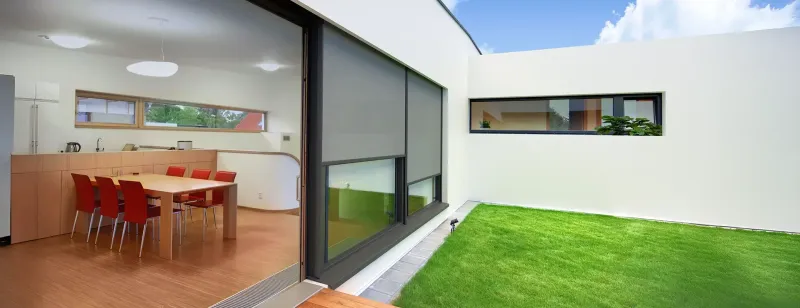
It is best to plan the selection of sunshades at the window design stage, rather than only after construction has been completed. Only then can the installation method, guides, control system and appearance of the façade be properly coordinated. In practice, the aim is for the su...

Choosing the right glazing should be taken just as seriously as choosing the window frame. It is the glass that makes up the majority of a window’s surface area, so it has a significant impact on whether the interior will be warm in winter and better protected from noise. In prac...

Modern construction is increasingly based on the premise that energy efficiency does not stem from a single element, but from the well-designed interaction between windows and doors and sunshades integrated with control systems. In this context, home automation becomes a tool for...